If you have osteoporosis, you may have heard that you should “watch your posture.” But what does good posture actually mean, and can exercise help?
The answer is yes. Resistance exercise can strengthen the muscles that help support and extend your spine, improve your posture, and help you become more aware of how you position your body throughout the day. Osteoporosis Canada recommends including exercises that target the muscles controlling the spine and shoulders as part of an exercise program for people with osteoporosis.
As a kinesiologist, I often remind clients that improving posture comes from developing the strength, mobility, and awareness needed to maintain a more upright and comfortable position.
Why Does Posture Matter When You Have Osteoporosis?
The upper back normally has a gentle curve. The shape of the vertebrae in the upper back naturally creates this forward curve. An increased rounding of the upper back is called kyphosis.
This curve can become more pronounced when someone has spinal fractures or weakened back muscles. Weakness in the muscles that extend the spine can contribute to a stooped posture.
An alteration of our natural curvatures of the spine (straighter or more bent) decreases the spine’s ability to tolerate load. This can lead to potential further fractures, loss of height, and disability. Studies also show that kyphosis of the upper back can increase your risk of falls as you age.
Strengthening the muscles that extend the spine can help you extend your back and improve your ability to maintain an upright posture. Stretching the muscles that bring the head and shoulders forward, like the pectorals and sternocleidomastoid (a neck muscle), can help encourage more upright posture.
What Does Good Posture Look Like?
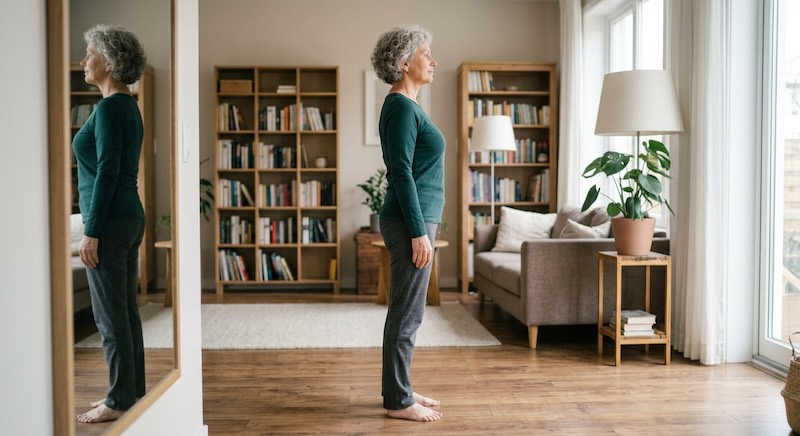
Osteoporosis Canada describes good standing posture as having the ear, shoulder, elbow, hip, knee, and ankle generally aligned when viewed from the side.
When standing:
- Distribute your weight evenly between both feet.
- Look straight ahead.
- Gently tuck in your chin.
- Gently draw the breastbone upward.
- Become aware of how you hold your head and body.
When sitting:
- Keep your feet flat on the floor.
- Sit upright.
- Gently tuck your chin.
- Gently draw your breastbone upward.
- Use support for your lower back, such as a pillow or supportive chair.
One important point: stay present and relaxed in your body as you practise these pointers.
Can Exercise Improve Your Posture?
Yes.
Current Osteoporosis Canada exercise recommendations include strengthening exercises for the muscles that control movement of the spine, shoulders, and hips to improve posture. Examples include side planks, rows, bird dogs, and bridges, which target the shoulder, core, hip, and back extensor muscles. It’s important to include the hips as well as the upper back. Shortened muscles at the front of the hip can also affect how we stand and move.
For people with osteoporosis, everyone is different. Exercise should be selected and progressed according to individual needs and fracture risk.
A Note About Spinal Extension Exercises
When looking for general posture or spinal extension exercises, you might notice that many involve bending the spine backwards.
This needs to be approached carefully.
It’s important to note that people with spinal fractures or a high risk of spinal fracture should avoid bending too far backward during exercises, because excessive extension can compress the posterior portions of the vertebrae.
This is why more is not necessarily better when it comes to posture exercises.
The objective is controlled, comfortable movement and improved alignment within a safe range. A kinesiologist can teach you the best exercises for your body and state of osteoporosis.
Gentle Posture Exercises for People With Osteoporosis
Throughout these exercises, aim for controlled movement and comfortable alignment, and avoid forcing your head, shoulders, or spine into a rigid or exaggerated position.
1. Lying on Your Back
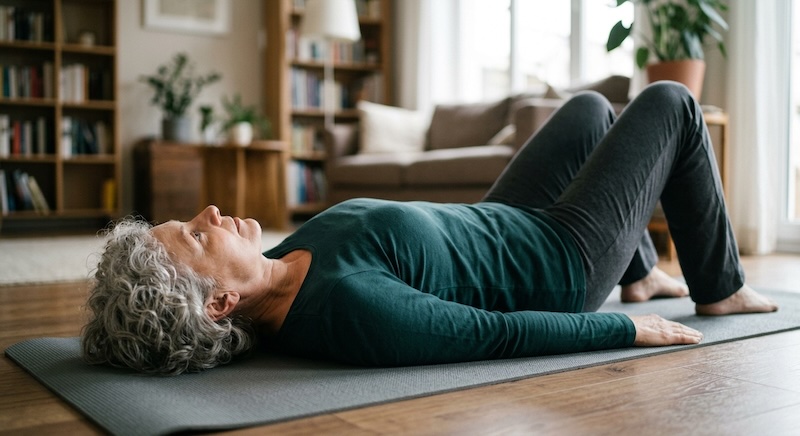
One of the simplest posture exercises involves lying on your back.
Lie face up on a firm surface with your knees bent and feet flat. If your head does not comfortably reach the floor or surface, a pillow can be used.
This position can encourage a more extended position through the spine and stretch the front of the shoulders and chest. Try practising this type of posture exercise for 5 to 10 minutes per day.
If you have had a spine fracture, positioning may need to be individualized.
2. Back Extensor Strengthening
The muscles that extend your spine are particularly important for posture.
Osteoporosis Canada recommends strengthening these muscles as part of posture training. A general recommendation for back-strengthening exercises is 2 to 3 sets of 8 to 12 repetitions, using an intensity that allows you to maintain good form while making the final repetitions somewhat challenging.
The appropriate exercise and progression will depend on your individual situation.
Here’s an example of an exercise that strengthens the back extensors:
Once you are comfortable lying on your back, you can progress to a gentle head press.
While lying on your back, gently press your head into the supporting surface and hold for approximately 3 to 5 seconds. Focus on maintaining comfortable alignment and controlled movement.
[Photo: head press]
3. Practise Standing Tall
Posture training also includes building awareness throughout your day.
Osteoporosis Canada recommends regularly practising good posture and becoming more aware of your posture during everyday activities.
A mirror can be a useful tool.
Stand comfortably and look at yourself from the side. Think about:
Head up → breastbone gently lifted → weight balanced between your feet.
Focus on becoming familiar with what an upright posture feels like.
How Often Should You Practise?
Consistency is more important than doing a large amount of exercise occasionally.
Here are some recommendations:
- Posture awareness: Practise throughout the day during normal activities.
- Lying on your back: Practise daily for 5 to 10 minutes.
- Back, shoulder, hip, and core strengthening exercises: Generally 2 to 3 sets of 8 to 12 repetitions. If you don’t have a fracture, aim for resistance training twice a week.
What About a Rounded or “Hunched” Back?
If you’ve noticed that you’re losing height, developing a more pronounced curve in your upper back, or becoming more stooped, don’t assume that it is simply a normal part of aging.
Osteoporosis Canada recommends that people who think they have lost height or developed kyphosis speak with their doctor for an assessment. Your doctor may recommend further assessment, including imaging, to determine whether you have experienced a spinal fracture.
If you have a spinal fracture or are at moderate or high risk of fracture, Osteoporosis Canada recommends having your posture assessed by a physical therapist before beginning posture training so that an individualized exercise plan can be developed.
Posture Is More Than an Exercise
One of the most useful things you can do for your posture is to take what you practise during exercise and apply it to everyday life.
Think about your posture when:
- Standing
- Sitting
- Walking
- Getting in and out of a chair
- Bending
- Lifting
- Carrying
- Performing household activities
You can combine posture awareness with spine-sparing movement strategies during everyday activities.
For example, when bending, use a hip-hinge strategy rather than repeatedly rounding through your spine. When you need to turn, stepping your feet rather than twisting through your spine can help you maintain better alignment.
These small changes can become habits over time.
The Bottom Line
Good posture is something you can practise and improve.
Strengthening the muscles that support your spine, practising an upright posture, and becoming more aware of your alignment during everyday activities are all strategies recommended by Osteoporosis Canada. It has been shown that exercise is important for bone health and decreasing fracture risk.
A simple place to start:
- Practise standing and sitting tall.
- Spend a few minutes each day practising posture exercises.
- Use [spine-sparing strategies](LINK TO SPINE-SPARING POST) like hip hinging and stepping to turn during everyday activities.
- Come see a kinesiologist who can help progress your exercises appropriately.
And remember: the goal isn’t to achieve a “perfect” posture. It’s to develop the strength and awareness that allow you to move confidently and safely.
If you have osteoporosis and are new to exercise or unsure where to begin, an appropriately trained exercise professional like a kinesiologist can help you determine which exercises are appropriate for you and how to progress them. Osteoporosis Canada recommends professional guidance for people with a history of spine fracture or those at moderate or high fracture risk, as determined by their doctor.
Bone Fit™ trained professionals are specifically trained in exercise for people with osteoporosis and related fractures, including back strengthening, spine-sparing movements, and full-body conditioning. At Symmetrix, I'm a Bone Fit™ trained kinesiologist at our Burnaby and Cambie Village locations, can help you with your goals. Check with your doctor or care team before starting a new exercise program, especially if you’ve had a fracture.
You don’t have to stop moving because you have osteoporosis. You can learn how to move with greater strength, awareness, and confidence. Book your initial assessment to start your journey to a strong and resilient spine!
Written By