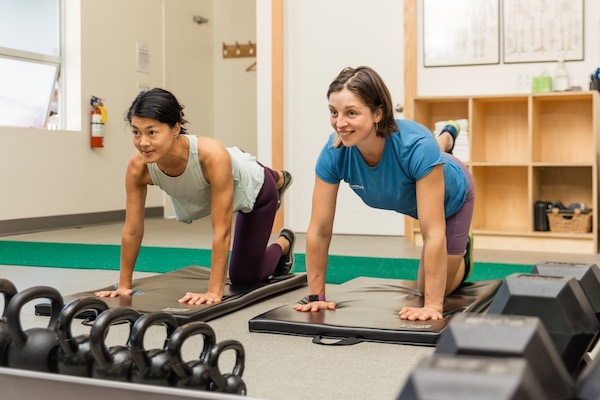
Kinesiology is an academic discipline: the science of human movement. Kinesiology combines anatomy, physiology, and biomechanics to understand how the body moves.
Kinesiologists apply their evidence-based knowledge to help you move your body better.
The term comes from the Greek word kinesis, meaning "to move." In practice, kinesiology is an active therapy: you'll be moving your body under guidance with verbal cuing, not being touched or manipulated while lying passively on a table.
What Does a Kinesiologist Do?
A kinesiologist uses exercise and movement to:
- Rehabilitate injuries from car accidents, workplace incidents, or sports
- Improve pain and chronic conditions like arthritis, diabetes, chronic pain, and heart disease
- Improve strength and performance for daily life or athletics
- Assess workplace ergonomics to prevent repetitive strain
Unlike physiotherapists who primarily use passive techniques (like needling or manual therapy) to reduce pain, kinesiologists treat the underlying cause through prescribed exercise programs.
Is Kinesiology Right for You?
You don't need a referral to see a kinesiologist. Consider booking if you:
- Have a nagging injury that isn't resolving
- Want to return to sport or activity after an accident
- Live with a chronic condition and want to improve function
- Need structured guidance beyond a gym membership
Read on to learn
Real Recovery: How Kinesiology Helped One Client Overcome Long COVID
Understanding what kinesiology can do is one thing, seeing it in action is another. We help hundreds of clients every year, so we asked one if we could share her experience.
Here's how a structured exercise therapy program helped one client rebuild her strength after a serious health setback.
The Client Starting Point
In mid-2023, a 58-year-old woman came to Symmetrix with a complex set of challenges: chronic low back pain, restricted foot mobility, intestinal inflammation, and severe fatigue from long COVID.
Her baseline fitness was significantly compromised:
- Could only hold a plank for 2–3 seconds
- Needed daily afternoon naps to function
- Found routine activities physically exhausting
- Had minimal exercise tolerance
Her goals were clear: eliminate the back pain, rebuild energy, regain strength, and lose approximately 20 pounds sustainably.
The Kinesiology Approach
Rather than jumping into intense exercise, we built a progressive program based on foundational movement principles—exactly what kinesiology training emphasizes.
Phase 1: Stability First
The initial focus was core and hip stability, addressing the root causes of her back pain rather than just the symptoms. This is where kinesiology differs from passive treatments: we rebuilt the support structures her body needed.
Phase 2: Functional Movement Patterns
Once stability improved, we introduced fundamental movements: squats, hinges, presses, and pulls, all with careful attention to form and pacing. These aren't arbitrary gym exercises; they're the movement patterns humans need for daily life.
Phase 3: Cardiovascular Progression
Endurance work started with short, structured intervals on the treadmill and elliptical. For someone with post-viral fatigue, pushing too hard too fast can cause setbacks. Kinesiologists are trained to manage this progression.
Sessions were twice weekly for one hour, starting with partner sessions before transitioning to one-on-one as her capacity grew.
Results After Two Years
The measurable outcomes demonstrate what consistent, guided exercise therapy can achieve:
She now performs squats, deadlifts, walking lunges, and elevated push-ups with moderate resistance—movements that would have been unthinkable at her starting point.
In Her Own Words
"When I started at Symmetrix over a year ago I had back pain and 3 years of sedentary life due to a chronic medical condition. My kinesiologist had the knowledge and experience to know how to get me moving again in a way that I felt supported and safe. I am amazed at what I have been able to achieve.
For each session I feel excited to see what my kinesiologist has planned. With her help I have developed a view of myself as someone who is continually progressing with strength, technique, power, and endurance. The back pain has gone and I feel strong and ready to tackle a physically challenging and athletic life."
What This Case Demonstrates
This recovery illustrates several key principles of kinesiology in practice:
- Active rehabilitation works — Passive treatments alone weren't resolving her back pain. Targeted strengthening did.
- Progression matters — Starting where the client actually is (not where they want to be) prevents setbacks and builds sustainable gains.
- Functional movement translates to life — The goal was never "lift heavier weights." It was climb stairs, play with family, and live without pain.
- Long COVID responds to structured exercise — Emerging research supports carefully progressed exercise therapy for post-viral fatigue, and this case aligns with that evidence.
If you're dealing with chronic pain, post-illness fatigue, or wondering whether kinesiology could help your situation, this is the kind of outcome that's possible with the right approach.
Kinesiology is the Science of Human Movement
Movement is what most people are doing most of the time, it's an enormous part of our collective human experience! Kinesiology is a science that studies human movement for to benefit our lives.
Research shows that without regular physical activity and exercise in our day, us humans become deconditioned (like an astronaught coming home from space). In this state we are more prone to musculoskeletal (muscle or bone) injury from the movement demands of everyday life. Picking up the mail, shovelling snow or carrying groceries can become riskier activities when we're in a deconditioned state.
Injuries also lead to loss of function, limiting movement and activity, leading to less function, leading to less movement and activity, and on and on. These physical limitation can spill over to other aspects of human health, affecting social health, mental health, and overall quality of life, and this cycle is amplified with age.
And it's because of scientific study on human kinetics that we know we need strong and supportive muscles and bones, and how to achieve this through movement and exercise. And kinesiology goes deeper still: the science shows that the human brain also needs practice coordinating with the rest of our body to stay healthy. Strength and coordination is critical for everyday activities of daily life like running for the bus, playing with the dog, and even getting up from the toilet. They are the two most important ingredients to a fulfilling life, quantified through high quality scientific research.
And this cutting edge exercise science is important to our government and citizens at large. By increasing movement on an entire population we go far beyond better fitness levels for that group. On a population scale people with better movement and mobility simply live longer and better lives. According to the Conference Board of Canada, if we were to improve Canadian’s physical activity level by decreasing the number of inactive Canadians by just 10%, we’d see a 30% reduction in mortality and free up our doctors’ time creating a more accessible healthcare system (CKA, 2020).
The importance of human movement is clear, it is fundamental to the enjoyment and length of life. So how does kinesiology work?

How does a kinesiology professional apply exercise science and movement expertise?
Let's break down kinesiology into individual parts so we can understand its practical components to our health. Registered kinesiologists are active in each of these areas: scientific research through collaborating with health professionals and working individually with clients.
Injury Rehabilitation
For post-accident injuries that resulted from workplace (WCB), vehicle (ICBC), or sport accidents movement is key. Kinesiologists can help clients with returning to work or sport in a safe and durable manner.
Chronic Health Conditions Management
Kinesiologists help with management of chronic conditions such as arthritis, cardiovascular disease, and diabetes through healthy lifestyle change and exercise prescription.
General/Sport Conditioning
This is one of the most rigorously studied topics in kinesiology and exercise science. A kinesiologist can provide specialized training to help increase aerobic or muscular strength/endurance in relation to specific goals. Goals can include training for a marathon, improving body composition or excelling at a specific sport.
Workplace Ergonomics
Biomechanics is an aspect of kinesiology that can be applied to the workplace. A registered kinesiologist can perform ergonomic assessments to analyze the current ergonomic design of clients' workstations and provide solutions and best health practices to maximize comfort and sustainability.
Healthy/Active Lifestyle
Similar to medicine, lifestyle is another major health topic to conduct research in kinesiology. With clients they provide guidance in goal setting, general diet advice, healthy habits, and introducing more movement into the daily routine. General fitness for clients who are physically active, deconditioned or special populations requiring additional training clients is common for a kinesiologist to do.
Neuromuscular Conditions Management
With training in anatomy, physiology, rehabilitation and biomechanics, kinesiology make a perfect platform for providing motor skills and physical training for individuals with neuromuscular conditions such as Multiple Sclerosis (MS), post-stroke impairments, spinal cord injury or motor control issues to help them perform activities of daily living. A kinesiologist might provide support for mobility, gait training, and strengthening for locomotion.
How do I access kinesiology, where do kinesiologists work?
Kinesiology is all around us! Kinesiology professionals work in the clinical setting such as hospitals or rehabilitation centres, in the community (in client’s homes), or at recreation centres (gyms/pools). You will find them where sports teams practice, insurance companies and at universities. Some registered kinesiologists may additionally travel for home visits. Wherever you are, a kinesiologist can meet you there.
Here are some common settings for registered kinesiologists to work in
- Hospital
- Multidisciplinary health and rehabilitation centre
- Fitness centres, gyms and pools
- With sports teams
- Universities teaching and researching
- Insurance companies

Who are kinesiologists and what training do they have?
Kinesiologists are registered health professionals. They are therapists that apply exercise and movement science to promote health and well being, prevent, manage and rehabilitate injuries and manage chronic disease. Kinesiologists can also restore function, and optimize human performance in the workplace.
Kinesiologists may be called by different names such as exercise physiologist, exercise therapist, athletic therapist or occasionally physiotherapy assistant depending on their training, specialty and setting. Regardless of their title, these exercise specialists have a goal to help you move and live better.
Kinesiologists have lots of training. An undergraduate degree in kinesiology and certification with the provincial kinesiology association are prerequisites to being a registered kinesiologist. Kinesiologists also are certified in Standard First Aid and CPR. Most kinesiologists focus primarily on injury assessment and rehabilitation (CKA, 2019).
One often overlooked fact is that kinesiology degrees are common for other health professions including physiotherapy and medicine. Health professionals often start with kinesiology as a pre-med on their educational journey to learn in-depth about how the human body moves. It's super common to meet sports medicine, mental health and physical fitness professionals who have a kinesiology background.
When thinking of kinesiologists at work, think evidence-based techniques performed with clients in one-on-one or in a group setting, which is an accurate description of kinesiology therapy. The kinesiologist provides personalized treatment in this way tailored to the client's goals.
What techniques do kinesiologists use?

The techniques that registered kinesiologists use vary from for each client, for each setting. Generally kinesiologists use a holistic approach to health and wellness, everything from strength training to healthy diet and sleep education.
The backbone of kinesiology in a clinical setting is a plan. With a background in strength and conditioning, a kinesiologists will create exercise programs and progressions that help clients get stronger while reducing the risk of re-injury. The kinesiology program will include and assessment, goal setting, and education on physical activity in daily life
For example a kinesiology program might look at proper movement patterns for daily activities like lifting and carrying at home or at the workplace. This can help with improving productivity and comfort in your workplace and in the field.
The cornerstone of kinesiology work with a client is an in-depth assessment where kinesiologists determine what techniques to focus on. Assessment picks up issues in your functional movement patterns like a squat and hip hinge. They compare your left and right sides to locate muscle imbalances through strength and flexibility testing. This helps a kinesiologists identifying and treating muscle imbalances that may be a root cause pain or dysfunction.
The assessment requires tools like a measuring tape and goniometer. During sessions they love foam roller, plio boxesHowever, the main tool in the kinesiologist's toolbox is exercise.
What types of exercises will I do with kinesiology?
A kinesiologist will lead you in performing a variety of different exercises that are tailored to your needs and goals. These exercises focus on strength, stabilization, and mobilization.
Some examples of exercises you may do in your session are:
- Squats and split squats
- Rows
- Bird Dogs
- Rotator cuff stability exercises
- Wall angels, open books for shoulder mobility
- Hip hinges
- Single leg balance, Bosu ball and stability board exercises
- Ladder work for agility
- Circuit training or cardio intervals for aerobic exercises

As Symmetrix clients progress through their exercise therapy program they regain control over their activity and physical health. Kinesiology is about developing healthy routines at the gym or at home to improve long term wellbeing for life.
Who is Kinesiology for?
If you have a body and you can move it, kinesiology can benefit you. As discussed above, kinesiology is about human motion. As an applied science kinesiology seeks to help anyone from elite athletes to someone with specific health problems.
Everything you've been told about the benefits of exercise is true, if there were a pill with these benefits we would all be on it. If better sleep, more energy, better mood, better weight control and lower risk of disease are attractive to you, consider seeking out a registered kinesiologist.
A kinesiologist can help you:
- Prevent and manage a variety of different physical conditions
- Avoid injuries from happening and help recover from them when they do
- Prevent and manage chronic pain
- Improve productivity and comfort in the workplace
- Save money on future health expenses
- Help you excel in sport-specific activities
In clinical settings it's common for kinesiology professionals to work alongside physiotherapists, massage therapists, occupational therapists, counsellors, psychologists and medical doctors.
Positive outcomes that come from working with a kinesiologist are:
- Decrease in pain
- Weight loss
- Return to sports or recreation activities
- Increase in strength, flexibility and cardiovascular fitness
- Improved body mechanics and function
- Improved outlook, confidence and life satisfaction
- Exercise skills
If you are seeking a kinesiologist make sure to see our post on 7 steps for choosing a kinesiologist.
What is the process when working with a kinesiologist?
Initial consultation
During a 15 minute phone consultation, you will share your goals and challenges, you will learn more about kinesiology, if working with a registered kinesiologist is right for you, and what’s to come next. You’ll be sent an intake form to fill out so your kinesiologist can best prepare and support you during your assessment.
Detailed Assessment
Your kinesiologist will ask about your physical state now and how you want it to be. In the one hour initial assessment you’ll dive more into your goals and define them further. Your kinesiologist will perform a functional movement screen with you to see what your current baseline is that will lay the foundation for the next step.
Program creation/implementation
You will work together with your kinesiologist to find exercises that work for you to get the results you want. Here the kinesiologist will create a program that will focus on stability, mobility, and strength.
Ongoing care and Support
Based on your progress your kinesiologist will help you with the transition to becoming more independent. This may look like a tapering of sessions or providing an at-home exercise program so you can continue on your own.
How to become a kinesiologist, and why?
People who choose to the study of human movement and to build a career in kinesiology have a connection to the field. Students stay if they are driven to promote wellness and improve lives - and they're usually very active folks. Registration, experience and a degree in kinesiology are the ingredients to working in kinesiology.
There are kinesiology programs available in high schools, colleges, universities, and even through private kinesiology courses where kinesiologists can be trained to work with clients online. Professional programs available for to upgrade kinesiology skills. The primary goal of anyone going into kinesiology is a 4 year bachelor's degree because it is required for registration.
Registration with a kinesiological association in Canada is't required by law, but seen as a necessary step to practice as a kinesiology professional after receiving their kinesiology degree. Each province has separate association of kinesiology, such as BC's BCAK (British Columbia Association of Kinesiologists). Registration with the association includes a criminal record check, references and screening for specific university courses. CPR and Standard First Aid are also requirements by their kinesiology association.
Kinesiology graduates get to move beyond scientific study and get hands on experience working through health issues. A kinesiology degree is perfect field for anyone interested in a career as a physical education teacher, athletic trainer, exercise physiologist, personal trainer or almost any other role in the fitness industry.
Why choose Symmetrix for Kinesiology?
Symmetrix Exercise & Rehab is a private studio specializing in kinesiology and exercise therapy. All of our clients get one-on-one therapy with a kinesiology professional – a highly personalised experience compared to the gym, but with space and equipment necessary to really get moving.
All of our clients receive professional exercise therapy uniquely tailored to their health challenges. Clients benefit from getting back to the activities that they love as quickly as possible.
Working with a registered kinesiologist means gaining access to a professional with deep experience providing exercise plans. In addition, thanks to our COVID “pivot”, we now have expertise with virtual sessions so clients also have the option to do sessions from home, online.
How can I learn more?
Book a free consultation with one of our kinesiologists today to learn more about how a kinesiologist can help you